
 EN
EN ES
ES ITA
ITA DE
DE FR
FRHow to Build Your Own Distributed Fiber Optic Sensing DAS System?

Basic Theoretical Knowledge
As an emerging technology, distributed fiber optic sensing is a complex interdisciplinary field that integrates optics, electronics, and computing. Therefore, before we can successfully build a DAS system, we need to master some fundamental theoretical knowledge.
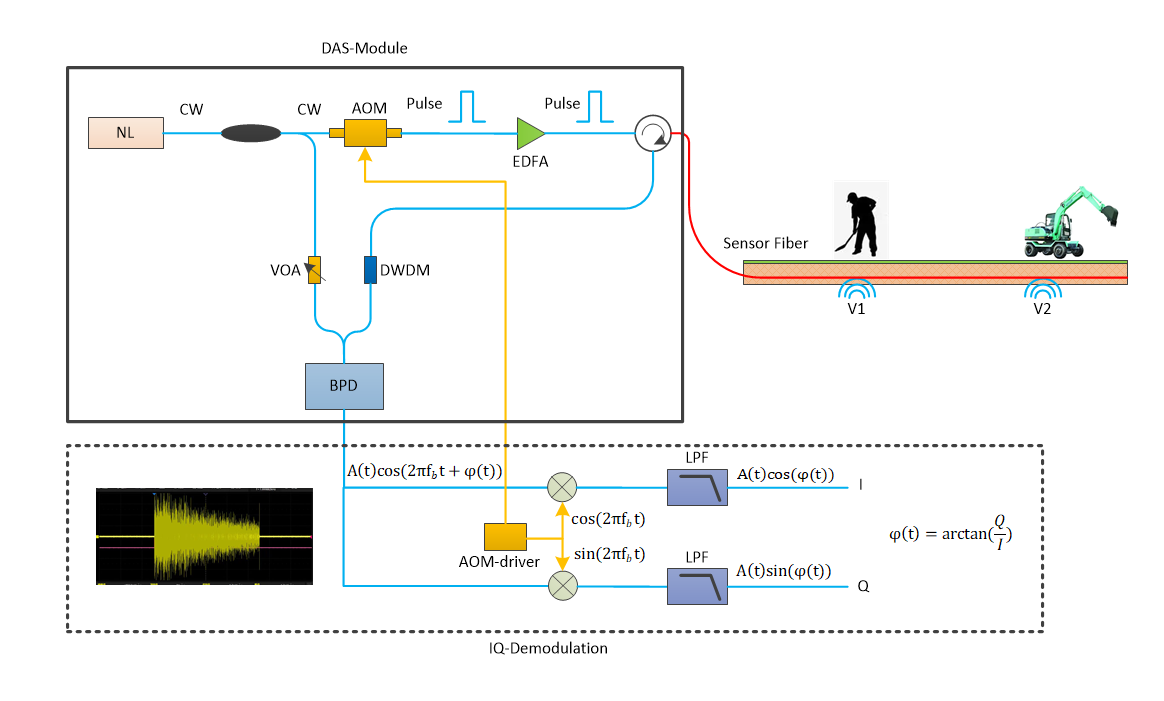
It is necessary to carefully read some literature early on in order to understand how a DAS system is implemented. A schematic diagram of a typical DAS system available on the market is shown below.
What Do You Want to Do?
I want to set up the whole system.
I am studying optoelectronics, and I want to make the laser driver, EDFA, and balanced photodetector.
I am doing FPGA work, and I want to develop the DAS demodulation and acquisition algorithms.
I need to become familiar with the principles of this system, set it up, and then develop some applications myself.
Everyone may have a different answer.
The distributed fiber optic sensing DAS system is a complex system that involves multiple functional components. For researchers working in optoelectronics or precision instrumentation, it is possible to selectively implement some component parts of the system. However, it is not recommended to try to make every single component yourself, as this is not only a technical challenge but also a matter of time. Therefore, it is advisable to choose some core components for self-development based on your professional direction and strengths.
Better Testing with a Reference
When carrying out self-development of DAS components, it is best to have a test fixture set, which facilitates rapid testing. Having a reference makes testing easier. Otherwise, it is inconvenient to compare, and you won't know whether the component you made meets the requirements.
For preparing the test fixture, you need to choose a specialized DAS hardware module manufacturer. This is because these DAS devices and components have been verified and tested before leaving the factory. If you purchase component modules from different suppliers and assemble them yourself, you may likely not be able to get the system working, or the result you achieve may not be optimal.
We can provide a complete set of DAS device modules. For customers who are doing self-development, we also offer a BOM solution of individual parts, and this component solution has been verified and can output excellent signals.
Pitfalls for Newcomers to Avoid
Since distributed fiber optic sensing systems involve knowledge from multiple disciplines and possess a certain level of technical complexity, newcomers often stumble into pitfalls. Common pitfalls are summarized below.
Building it according to your own understanding: Based on literature you have read and your own understanding, you think that simply purchasing the necessary devices for the system will allow you to build it and achieve the desired results. However, the reality is: you cannot get it to work, or even if you can build it, the result is poor.
Choosing products without technical support: Insufficient research on device procurement, buying products from optoelectronic companies whose main business is not fiber optic sensing. After purchasing, there is insufficient technical support, especially when the supplier cannot provide any help with later-stage signal processing.
Bought modules/DAQ cards but don't understand demodulation: Purchased DAS modules/DAQ cards from some companies and, after receiving them, are able to collect data through the manufacturer's upper-computer software but do not know how to perform demodulation processing, and the manufacturer is also unable to provide support.