
 EN
EN ES
ES ITA
ITA DE
DE FR
FRPrinciples of Four Common Types of Fiber Bragg Grating (FBG) Sensors

Principles of Four Common Types of Fiber Bragg Grating (FBG) Sensors
Overview
Fiber Bragg grating sensors feature high precision, high sensitivity, small size, flexibility, and embeddability. They have developed rapidly in the sensing field and have become one of the most representative sensors in fiber optic sensing. Various sensors fabricated using fiber Bragg gratings for different purposes have also emerged.
Essentially, FBG sensors are a type of fiber optic sensor. They are fragile and prone to damage when used directly. To extend their service life and improve sensing performance, they are typically encapsulated for protection. Through different packaging structures and materials, they can be adapted for various applications, enabling the measurement of parameters such as temperature, strain, pressure, and acceleration. Based on the packaging method, FBG sensors can be classified into tubular, substrate-based, embedded, and suspended types. According to the packaging purpose, they can be divided into protective packaging, sensitivity-enhancing packaging, and compensatory packaging. This article introduces several common types of FBG sensors formed through packaging.
1. Fiber Bragg Grating Temperature Sensor
The temperature sensor is one of the earliest applications of FBG sensors. Its temperature sensing mechanism is based on the thermal expansion and contraction of the fiber grating, which causes changes in the grating period and effective refractive index, thereby shifting the center wavelength of the FBG. The temperature variation is measured using the relationship between temperature change and the center wavelength shift. Since bare FBGs are fragile, they are generally protected by an outer casing. Currently, most commercially available FBG temperature sensors use a capillary steel tube package.
As shown in Figure 1, the FBG temperature sensor typically encapsulates the fiber grating in a capillary glass tube. One end is fixed with adhesive, while the other end remains free inside the glass tube. The capillary glass tube is further protected by an outer steel tube, and high-temperature thermal conductive oil is filled inside to enhance the heat transfer rate. This structure effectively shields the FBG from external strain. This packaging method not only protects the FBG but also resolves the cross-sensitivity issue between temperature and strain.
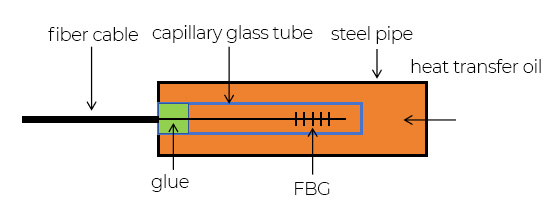
Figure 1: Schematic diagram of FBG temperature sensor packaging
2. Fiber Bragg Grating Strain Sensor
The strain sensor is the most classic application of FBG sensors. Its strain sensing mechanism is based on the photoelastic effect when an axial force is applied along the fiber grating, causing changes in the grating period and effective refractive index, and thus shifting the center wavelength. The strain is measured using the relationship between strain variation and the center wavelength shift. To measure the strain of a target object, the FBG strain sensor is typically bonded to the object using an adhesive. The FBG and the target deform together, so the measured strain of the FBG represents the strain of the target.
As shown in Figure 2, the surface-mounted FBG strain sensor is often packaged in an I-shaped structure. The main body is an I-shaped steel plate, with the FBG attached to the central axis of the middle steel plate. The two bases are fixed to the target structure with screws. Experiments have shown that this packaging structure effectively protects the FBG, achieving a high survival rate and good linearity between strain and wavelength. However, the strain transfer loss at the measurement point is about 20%, which can be corrected through calibration.
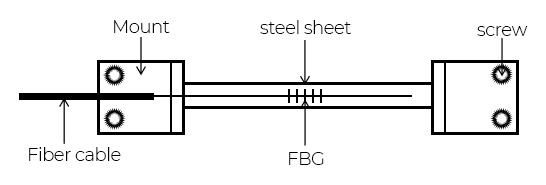
Figure 2:Schematic diagram of I-shaped FBG strain sensor packaging
Since FBGs are cross-sensitive to both temperature and strain, the effect of temperature change must be eliminated in actual strain measurements. Typically, two FBGs are packaged (one affected by strain, the other not) for temperature compensation. As shown in Figure 3, two FBGs are encapsulated in a stainless steel tube. One FBG is placed in a tight jacket; when the steel tube is stressed, it deforms, and this FBG is affected by both temperature and strain. The other FBG is placed in a loose jacket, allowing it to move freely without being affected by strain; thus, this FBG measures only temperature, and its purely temperature-sensing characteristic is used for compensation.
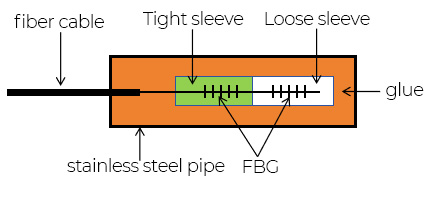
Figure 3: Schematic diagram of FBG strain sensor packaging with temperature compensation
3. Fiber Bragg Grating Pressure Sensor
When a bare FBG is directly subjected to pressure, the shift in its center wavelength is very small, and its pressure sensitivity is very low. Therefore, appropriate packaging is required to enhance sensitivity. Currently, mainstream FBG pressure sensors are mainly based on axial strain measurement, with two common approaches: adhesive bonding and embedding.
As shown in Figure 4, the cantilever beam bonded FBG pressure sensor typically encapsulates a cantilever beam in a sealed metal wall. The FBG is attached to the arm of the cantilever beam, and a transmission column is located at the free end of the cantilever. When external pressure is applied, the transmission column transfers the pressure to the cantilever, causing it to bend and deform. The FBG measures the strain of the cantilever to characterize the external pressure. Encapsulating the cantilever beam in a metal wall effectively protects the FBG, allowing for large pressure measurements with high accuracy.
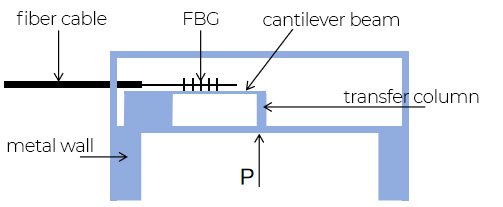
Figure 4: Schematic diagram of cantilever beam bonded FBG pressure sensor packaging
As shown in Figure 5, the embedded FBG pressure sensor typically embeds the FBG inside a pressure-sensitive material, which is then protected by a metal housing. The pressure-sensitive material is generally a polymer characterized by low elastic modulus and high pressure sensitivity. When external pressure is applied, the polymer stretches the FBG, enabling the measurement of external pressure. The advantages of this packaging method are its simple structure and high sensitivity to external pressure. The disadvantages include lower pressure measurement accuracy and poor stability due to the aging tendency of the polymer.
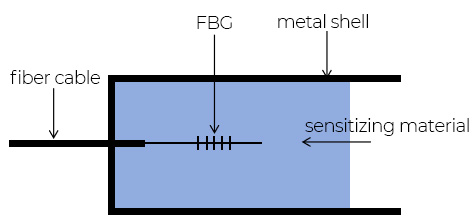
Figure 5: Schematic diagram of embedded FBG pressure sensor packaging
4. Fiber Bragg Grating Acceleration Sensor
The FBG acceleration sensor uses an elastic element to convert the displacement caused by vibration from the measured acceleration into strain in the FBG, thereby achieving wavelength modulation. The ability of the elastic element to accurately transmit the acceleration vibration signal is critical. Based on the structure of the elastic element, FBG acceleration sensors can be classified into beam-type, spring-type, and hinge-type.
As shown in Figure 6, the beam-type FBG acceleration sensor generally consists of a cantilever beam and a proof mass. An FBG is attached to the cantilever beam. When external acceleration vibration occurs, the proof mass drives the cantilever beam to deform due to inertia, and the acceleration is measured by detecting the strain in the FBG. This packaging method results in a simple structure suitable for low-frequency acceleration vibration measurements. Since the strain measurement relies on bonding, it is significantly affected by temperature, so temperature compensation design is required.
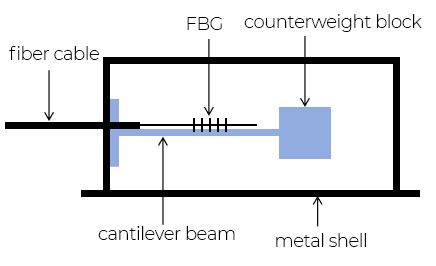
Figure 6: Schematic diagram of beam-type FBG acceleration sensor packaging
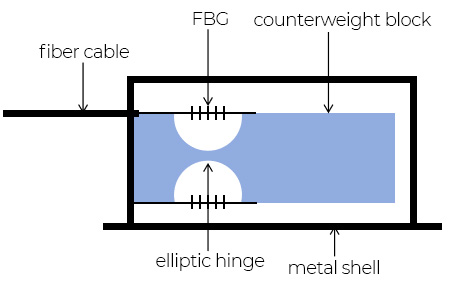
Figure 7: Schematic diagram of hinge-type FBG acceleration sensor packaging
As shown in Figure 7, the hinge-type FBG acceleration sensor packaging structure features FBGs attached in suspension at both ends of a flexible hinge. The principle of acceleration measurement is the same as that of the beam-type FBG acceleration sensor. By attaching two FBGs at the upper and lower suspended positions of the hinge, mutual compensation is achieved. This structure offers advantages such as frictionless operation, high accuracy, and immunity to temperature effects.